SidharthHey, thanks for joining. this is Satapayduzi community. My name is Satish, and, a little bit introduction about me. I'm a founder. I have a company called, Tua Solutions. we do services basically. We are into, list services as well as, software services and, services. So we are here for, Tua is almost for two years now, and then during this time, the journey was quite long. It was not that easy. So I thought, why not, have a community where we can founders can share their, challenges, what they have gone through. Building the gym, and that helped other founders to speed up the gym.
Startup A2Z Community Meeting
The meeting features discussions on the Startup A2Z community, sharing challenges faced by founders, and insights from successful entrepreneurs. Key topics include the importance of community support, strategies for startup growth, and experiences from guest speakers.
0:000:00
The meeting features discussions on the Startup A2Z community, sharing challenges faced by founders, and insights from successful entrepreneurs. Key topics include the importance of community support, strategies for startup growth, and experiences from guest speakers.
9 Speakers
- Sidharth
- Daniel
- Megha
- Siddharth
- Sharan
- Andy
- William
- Satish
- Michael
Convert your Audio Video Files to Text
Speaker Separated TranscriptionAccurate
Free for files under 30 minutes
The meeting features discussions on the Startup A2Z community, sharing challenges faced by founders, and insights from successful entrepreneurs. Key topics include the importance of community support, strategies for startup growth, and experiences from guest speakers.
9 Speakers
- Sidharth
- Daniel
- Megha
- Siddharth
- Sharan
- Andy
- William
- Satish
- Michael
SidharthSo that's why even, the logo Startup A2Z, A C Z's, success. So we are trying to bring those two closer. So that is what Startup A2Z
Sidharthmeans.
SidharthIf you guys are interested in SOC two or, AI security assessment, you can catch up with us. So that's what we need. And then value essentials, you have, water behind and then tech, the laptop table. Wi-Fi is there, there are two, boards you can just get the Wi-Fi, and then restrooms are behind. So Startup A2Z has got, three parts to it. So one is, we call these three things. One is fundamentals, startup fundamentals. it's a kind of, workshop usually. So today we are not doing startup, fundamentals. Today it's more of founder spotlight and, actually two founders, spotlight.
SidharthOne is from Sith and the other is from Daily, who is from this.
SidharthSo our vision is to
Sidharthbring, seed and success as close as possible by helping each other and then, if somebody has already cracked a particular, challenge and if, new founder, he wants to, I mean, if he is already, if he wants to do the same challenge, it will take a long time, so the idea is to reduce that as much as possible. this is our WhatsApp community, as well as our website. please join. We will send you updates, and this session is, we usually do weekly, weekly cadence, mostly every Tuesday, based on the hourly rate. you can use our website to add your business.
Sidharthif you are, if you want to talk over here, to apply a pitch, you can use our website. And then, founder story, what we do is, the story, whatever, people share here. There's, there are some secret sauces could be revealed. Right? so all those things will be captured, and it will be part of our website later you can, read through that. A quick journey or walkthrough about, the website.
SidharthSo this is the community website.
SidharthSo if you want to, talk, there's apply for pitch. We usually have galleries. So today's gallery also we will be posting. Here you can see gallery as well as, we do recap, complete recap about the founders. And then what important thing is, is founders playbook. So whoever comes and gives a talk and if there is any, founders, if they have some of the challenges which they have, cracked, right? So all those things you can find here. These are some of the founders who have cracked and then though all those information is available for you. So this is a very good place to get started as a founder.
SidharthWe'll also support you with various other services if you are looking for IT services, and to kickstart your founding journey, we'll, we'll help you there. So we'll ensure, the journey between C to success is as smooth as possible. So that's about our setup. So today's speaker, we have two, talks. One is from Siddharth. So Siddharth, he is, a co-founder and CEO of, Meesho AI. so he's a very, I mean, he's a successful founder who will be sharing some of, some, some of his journey, the challenges he faced, and, how he overcome, which could be learning for us.
SidharthSecond is, Daniel. He's from this. I hope everybody know this is acquired by, Google. so Daniel will be talking about this story, his, this journey, how, what were the challenges, things like that, and also some of the opportunities with this he will be sharing. So that, that, that talk also will be really good. So that's it, pretty much. my ask is if you want anything, let me know, website is there, please log in, please register, and then say in touch, if any questions,
Sidharthwe shall just ask. We are here to help. yeah, just, thanks to, sorry, the whole staff. Thanks to Megha, Sid, and, Mira
Sidharthfor helping me organize this and then help out. So with that, let's start with, Sid.
SidharthSix
DanielHi. Hey guys,
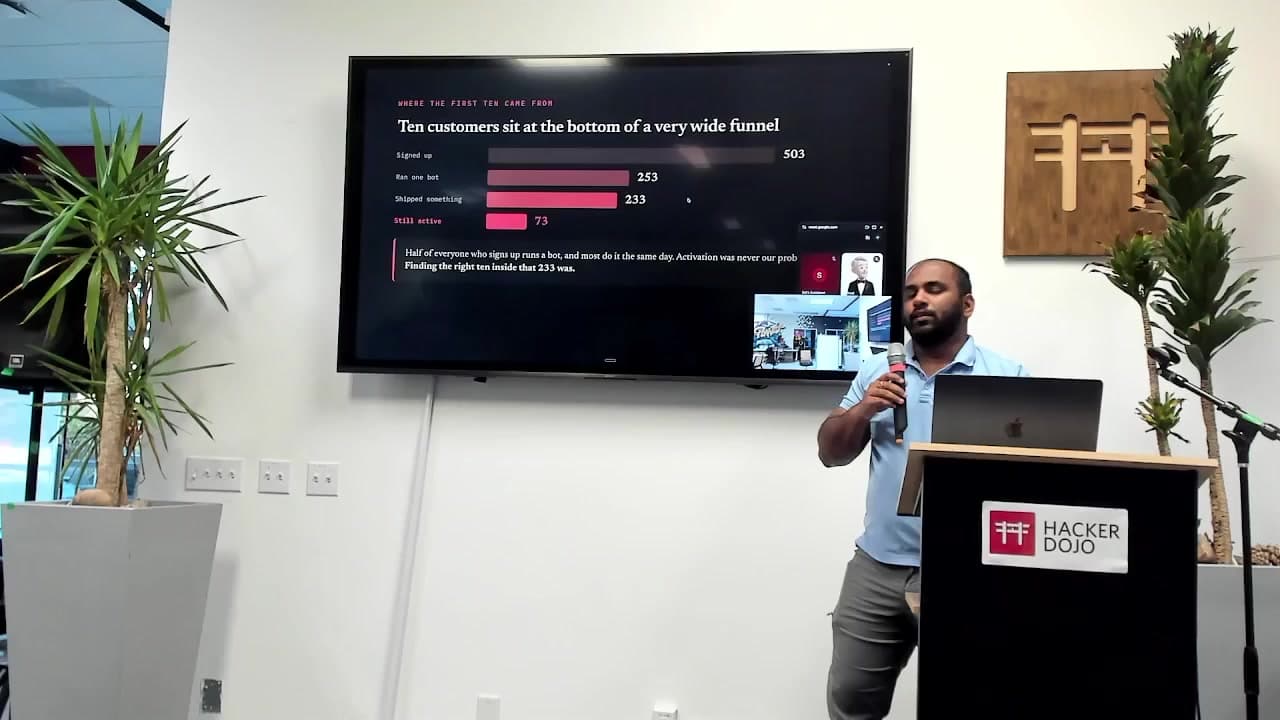
Sidharthgood evening, everybody. I'm Seth, co-founder of Minting.ai. a little bit of background about me. before this, I bootstrapped for eight years an AI consulting firm to a couple of million dollars, from India, selling to the world. then, built a couple of products. One was backed by Meta's XR Accelerator program, but the Meta was boom was very short-lived, so we couldn't really take it off. And, then it's been a year and a half since I started building the extreme, and I'm gonna share, share, share a little bit intro about what we're building, showing a quick demo, and then I'm gonna jump right into, some of the lessons or some of the challenges that you'll probably face in finding your first ten customers.
SidharthThat's the theme that I've taken essentially. So I think the problem we're going after is, we spend about five hundred billion hours in meetings. However, the meeting data is either not captured, or even if it's captured, it's heavily underutilized. It's just sitting somewhere. And every agent company in the market today needs this data. Your CRM agent, sales agent, HR agent, you name it, and, you know, everything agent. Every, every agent needs context, which is listening in meetings. But for those agent builders and product teams to capture it, it's pretty painful. you have to deal with different platforms, onboarding programs, you have to deal with real-time streaming, scalability, stitching together STT, LLM, TTS, ones, and so on and so forth.
SidharthAnd, that's, that's what we solve. like we help, any agent to easily connect to our platform using our unified API. we also are building the first voice infrastructure. Our thesis is that, the meeting rooms will have voice agents talking to you. So imagine your note takers. How many of you here use note takers? Just a quick raise of hands. Oh, that's surprisingly low. I thought everybody was there. But yeah, I mean, if you are using NodeTakers, we believe that, you know, these NodeTakers will evolve into voice agents that are talking to you, that are representing you, are taking actions on behalf of you, in meetings.
SidharthSo that's, that's like our vision. And, yeah, so what we build is basically we give a single API. So we sell to developers. I'm just setting context here to share the journey and how it worked out for us. So we sell to developer and product teams, and, we give an API that lets these developers programmatically access meetings, put an agent into a meeting, real-time audio, real-time video, all of that. so good demo as well. So here in the meeting I have Alfred, who's my news agent. And since assistant, so you can basically talk to them.
SidharthSo if I go, hey, since assistant, can you still hear me? Yeah, since assistant, can you give a short introduction? And Alfred, if you're there as well. Sure.
SidharthOne sec. I'm trying to retrieve the AI, and Alfred is
Sidharthon hold on the session area. What else can I help? No, I mean, you, you get the idea. You can build any voice agent. Eventually we see, you know, even individuals who are using personal agents to send those agents to some meetings on their behalf. And, that's sort of our thesis, and the whole idea about Webility. We're not a note-taker, we in fact sell to note-taker companies, we are a agent infra for meetings, and we're not just recording, as well, we are also streaming data back to the meeting, as you just saw in the short demo.
SidharthAnd, yeah, so who builds on top of us? Who are our customers? So we sell to B2B or B2C SaaS teams, so we have more than hundred products on board and on our platform today, across industries, sales tech, HR tech, customer success, conversation intelligence, enterprise, and there is a bunch of more industries that we have customers in. And, yeah, we're also, we just launched, we are like four months in pub- private beta and a month in public. We just launched in August, it's exactly been a month, actually. yeah, and we're at like two hundred K ARR, over a seven million dollar pipeline, and growing more than fifty percent month on month.
SidharthAnd yeah, that was, that was this, just the deck, that was what, we're building at Mainstream. but I want to walk through about, like, how you get your first ten customers or first ten paying customers that actually validate your product. And, finding that has been, there, there was a lot of insights of, there was a lot of problems and mistakes that I did during
Siddharththe
Sidharthprocess. Yeah. So, yeah, lot, lot of lessons along the way that I have been doing, building Mainstream in the last one year, which I would probably do differently if I built a product again. And, you know, I think or two that you might take away. yeah. So first is design who to work with. you know, this is a very tricky question that all of you might have. Online, and you know, the, the whole magical world of ICP and ideal customer profile and all that comes into play. that is something that, to be very honest, till date, even after having hundreds of users, we don't know who exactly is, ICP.
SidharthWe do have a fair idea, I wouldn't say that we have no idea, but, you know, finding that high intent buyer or your ideal customer profile is still something that we are tracking. But in the early days, you know, you might be confused, should I go after enterprise, should I go after mid-market? And a lot of people say like, hey, you know, start with mid-market, they'll give you the product maturity, and some will say enterprise, and some will say startups. and honestly, it's not a one-size-fits-for-all advice, that anybody gives about working with a certain company.
SidharthIt is heavily contextual on what you're building. But for us, we could technically sell from anywhere to an early-stage startup to an enterprise. But then we decided to take, early stage startup, which I, I, I think was a better decision, because A, the, early stage startups are much quicker to adapt your product, especially if it's a developer product or API product, something that has to deal with an infrastructure, the appetite for risk and the appetite for, getting, or, or trying something new is much higher with startups, and that easily helped us shape our initial, product version, features, roadmap, everything.
SidharthEverything was driven by, you know, the early stage companies that we work with. But the worst, worst part about working with early stage companies is they don't have money. So you're not gonna be making a lot of money, or if any money at all from early stage companies, because they're also pre-seed, they're also early stage builders, they're also seed stage founders, so they're trying to figure it out themselves. So it's a trade-off that you have in early stage startups. but it's, it's a decision that you have to take. Okay, if you're not, if you are not sure about whether your product is adding value, is it, is it good enough, is it ready enough, I think working with early stage startups is the best thing, and then you can slowly move up market into mid market.
SidharthSo this is another challenge that we face working with mid market, which is that they expect a lot of features, so we ended up building a lot. And then enterprise gets even more crazy, like they, they need soft tools, you know, you, you need everything, compliance, everything at day zero, which is, which is expensive and, not something that you want to be putting your energy on, on day zero. So, yeah, in, in my, when, like I said, to start with, it's heavily contextual. If your product is only an enterprise product, it probably makes sense to start with the enterprise itself.
Sidharthbut on most cases, if you're building a SaaS or if you're building an agent product that could apply across categories that anybody could use, then my recommendation would be to start early and then move mid market and then up market. A pay cookie. And, that's something that I think one of the positive lessons that I had as an experience. And, you know, we basically ended up working six months with a company that didn't have a budget. Did we get revenue from them? No. At the end of the day, they're probably like a fifty dollar per month customer.
SidharthBut they did, become our beta testers. They were very tolerant with all issues that we had in production. They were very, you know, helpful in terms of shaping up the product maturity. And, yeah, that's, that's like the takeaway on who to work with in your early days and like who, who your initial customers could be. And, and then next is designing water well first. This is something that me and my co-founders, debate at a lot, and I think we still do at some point, because it's a, it's a mix of reaction from the market, it's a mix of reaction from your customers.
SidharthBut one thing that we decided early on. So, I mean, very, very contextual to our product, but one thing we decided early on is that we don't build anything that our customers, don't ask for. Like, we don't write a single line of code that is not requested by a customer. So one of the things that we did, which I'll cover later a little bit deeper, is that we had a landing page out on day zero, even before we started working on, like, writing a single line of code, we had a landing page on, and in that we started capturing in-time requests, feature requests, and then we start having customer conversations.
SidharthAnd, yeah, I think, I think that helped us. So, so the first, very first thing that we decided to build was a basic capability, like it was for us at that stage an example for our product. Can the bot join the call? You know, can it get the raw audio? Can it, can it have, can it be cheap other than the market? And can it move fast? So that's, that's like the very basic version that we built out. that the early stage companies wanted. And then, we had, the mid-market, they had, like, a lot of complex, that we, that took us another four, five months to build out, which basically meant, like, you know, having their own servers, having their own storage systems, having webhooks, SLAs came into play, like, where they wanted, committed numbers and, stuff like that.
SidharthSo, deciding, like, one, one rule of thumb that, I think really helped us, and we sometimes steer away from the market and the noise and everything that's happening around is, getting carried away and building features that your customers never asked for. So I think, trying to stay very close with the customers, very close with everything that they want, is, is the ultimate. And, and again, there is another, Another deadlock that we sort of carry, got into, which is where we ended up spending a lot of time on one feature that was wanted by one customer, whereas we had like a lot of smaller things that we could have done that could have opened doors for ten other customers.
SidharthSo being able to score and tag every feature, you know, every, every single feature to a customer and giving a weightage to it. Okay, hey, is this customer, I mean, if it's like OpenAI, obviously, you know, you can, you can spend a lot of time building that one feature for OpenAI if, if they've signed something with you, if you have a potential, you know, pilot. But if it's, if it's not really a big logo or a big name that's not going to move the needle, I think scoring the roadmap very tightly is super important. We could have saved, I guess, just like two or three months.
Sidharthin, in retrospect, if we had done it more efficiently, we didn't do it at first, but then we, we later picked on, and that is something that we do now for every feature, that we do. And, yeah, so that's like the button that we are scared of pressing, right? Like whether we ship something that is super cool for our design partners or whether we build something that is very boring, but someone who's ready to pay wants. So, yeah, score it properly and pro- have, have that decision matrix from day one. I should have done that.
SidharthI wrote for probably the first four or five months. We, we realized it pretty late and got onto it. And, another trap, that really costs us time. So these are, these are mostly like very my lessons of like the pitfalls that I did for my first ten customers, which I could have like shorter, done it in 2x the speed. So one of the thing was a pilot, right? Okay. So in early days, you are really desperate for customers. You really want someone to use your product. So you end up saying, hey, okay, let's do a pilot and you just jump onto the pilot, right?
Sidharthbut then you get into that, that loop of, okay, when does the pilot end? And, or they keep asking new features, they keep asking, you know, they are like, okay, let's run a pilot, let's, let's do a twenty one day. And, you know, let, we, we kept it loose ended until, because we wanted users, we wanted to show users and all of that. So what happens is we onboarded them to a pilot, one week, two weeks in, they probably didn't even integrate, and then we built a couple of features for them, and then it, the, the, the two or three week pilot that we had in mind ended up becoming three months because there was no proper agreement that tied down to it, even though it's like a very micro, I mean, like we are a very small feature in a product, and our customer ACVs are anywhere from like Thousand or two thousand dollars to
Sidharthtwo hundred thousand dollars from a single customer, depending on the states they're in. But that said, for, this was for a, this was for a thirty K contract where we spent six months, because we didn't tie it into a timed project execution document, and we didn't, really set, like, you know, the meetings in, in an exact schedule. So that's something that I would do differently now, and which we do with every pilot that we onboard. If they are a pilot, if they're not willing to pay, upfront, I mean, try to get a big pilot. If you cannot, then tie it into an agreement with exact dates.
Sidharthyou know, have an execution doc signed on day zero. Like, that's what I do. Like, we, we put the numbers, we put the timeline, we put the effort. we also tell their effort, you know, especially from a product like ours, where there is little bit of integration and onboarding since we're a developer product. we, we also need to get some of their team's efforts, so making sure you put that in their cost of implementation. And, yeah, and, and measure the entire thing against, okay, where they were and where they are. yeah, it's, it's a whole sales process, but you need to do it early on, if not, you're gonna be in that loop and you're gonna end up spending too much time on somebody who's probably not ready to pay or probably not urgent enough to buy.
SidharthAnd that is something that I learned, which was like always be qualifying, like always be qualifying your customers, like every day or every week, qualify the pipeline that you have on who's your most urgent and most idle buyer and, you know, put them through this loop so that you don't end up spending a lot of time on, multiple pilots.
SiddharthYeah.
Sidharthso when I say qualifying, it's basically, Some of the, I mean, again, it is contextual to the product, but for us, the qualifying factors were, how soon is it in their product roadmap? do they have the buying capacity? Do they have the development bandwidth? Are they bleeding money? There are like different indicators or signals that, contribute to qualify them and score them. So for us, it's the volume as well, like, are they just building the product? because if they are, then they're not really going to have like production volume for at least two, three months.
SidharthThat means that they're not really going to face, you know, be a paying customer. That's one aspect. The other is that they're not really going to need a lot of our product. It's just like the basic things that they need initially. So you define these qualifying metrics for your product and your company that, is unique to your ICP as well. Like there are different signals for us. It's like, the number of hires, or the number of customers they have, the, the, Number of hours, the infrastructure is already utilized. So there are like different factors for us.
SidharthSo we sell a usage base, so we, we typically charge them by the hour. So the, the number of hours they use is important to us, in, in terms of both building capacity and also delivering and also, revenue. So it's all tied to the number of hours. That's like our North Star metric. So getting that and using that to qualify is, is what we, is what I meant by always be qualifying. So, yeah, that also means like whatever pilot you get into it, you know beforehand, is it worth it? Is it really going to, is it really someone who you want to work with?
SidharthRight? And, yeah. And, and the ultimate question, like, okay, I talked a lot about customers, but I didn't talk about, like, how do you reach them? How did you get the first ten or, you know, now we have a hundred customers, but how, how did we, get that? So I think initial days, so, so it's, it's, it's different at different stages, but at initial days, you really want to get maximum reach, as you want, like you want to be out there in events, you want to be out there doing your own. Hackathons was relevant for us because we are a developer product.
SidharthWe hosted hackathons on, like, even before we had, like, a full mature product, we just had, like, a basic version of our API, but we still went on to do the hackathon. that gave us a couple of customers, a LinkedIn outreach. I was, I was maxing out my LinkedIn connections every day, cold emailing, referrals, trying to get, like, you know, build an idea of who could be our potential customers, asking, communities, inbound, inbound, so inbound is something that, still works very well for us, and, I would always advise any product team to invest from day zero.
SidharthEven if you don't have the product, you can actually talk about your product and write about your product. So which is something that's in your head, something that you probably have unique insight on, something that you learned. so, for context, the first year we onboarded, for the, for the entire first year we onboarded hundred customers, like hundred users onto our platform, but in August we onboarded one twenty. So all this was, actually sixty percent of that was inbound, and, forty percent is the rest that I still do. so yeah, in initial days, try to, try to build a pattern, but I think as, as time passes, even what I am trying to do now is trying to take one or two decks or one or two channels that works well from all this data.
SidharthI have the data for one year that, hey, these are all how I got the leads from, so now I'm trying to pick the top two or three and putting more effort on that. but ideally, in the initial days, you know, you want to be doing maximum, maximum distribution. Distribution is everything. And, Yeah, so I was, everything was going on, every side, and, we were like, we have to do it. So I think the metric was, we were reaching uniquely over, two hundred people a day, at, at the early stage of Slack. A couple of LinkedIn accounts, emails, all, all, all together.
SidharthAnd that's like six thousand. That's actually very low, considering we, we have now do a lot more volume through proper mechanisms in GTM. But yeah, that's what we started with. And, yeah, and, and, your ICP, so the, the way you discover your ICP is basically by talking to enough people, right? Like, initially you start out with a hypothesis or an assumption or with one, maybe one or two people that you spoke with who said, hey, you know, I would buy this, this is a great product, this is a great idea, you know, who, who gave you that initial nudge.
Sidharthbut like for us, it was a very initial guess that, hey, okay, everybody's building note takers. You know, the infra is hard, there was only one product in the market, and we were like, okay, why not? let's, let's build it. And at that point, I only spoke to like three or four, four users, and it was my own problem. I was trying to build a AI agent that could pitch in meetings, and there was no infra, and I was like, hey, why is nobody building it? And then, and then I spoke to three or four people, they validated it.
SidharthSo that was my initial start. and then we realized, hey, okay, who's the buyer? Who's the champion? Like you, you start seeing all those different patterns, and who's our, you know, more highly likely buyer. So today, it could be funded teams, shipping agents that act on their own, like that's, that's a very broad way to put it. Like I said, we're still like drilling down our ICP, but it has evolved a lot since the day we started to now in terms of defining The, defining the, the, the factors that determine an ICP. So, yeah, and, yeah, this is something that I feel like we did wrong.
SidharthSo the, the fact that we onboarded a hundred people, or a hundred customers, we, we, we are B2B, so when I say a hundred, it's, it's businesses, essentially. some of them might be like indie hackers, but they're, they're still running like products. So, we only launched this August, and we launched private beta, four months ago, or mostly because our product was not ready, but even today I feel like our product is not ready, so, one thing I would say, like, one thing I would say is, like, launch more frequently. I feel like we, we could have created a lot more momentum or spoken to a lot more people, even without the product.
Sidharthmore, you know, when I say launch, launching could be different things, but it could be just like posting on social media, launching on product on Reddit, product on Reddit X launch, Reddit LinkedIn launch, we did all of that just last month. And that was actually very great. Like I'm, I'm now thinking, working with my team on like, hey, how could we launch every month or every week to the point where we, we are shipping something every week anyway, why, why don't we put it out there? Why don't we make it, like, why don't we announce it?
SidharthWhy don't we make a thing around it? So launch, sooner, I think if I had done that, I would have probably landed a little bit more bigger names, who were interested in a pilot, and I could have nurtured the relationship when our product was ready to just jump in and try out. the launch actually landed us a lot of meetings, and, it was pretty good. so, yeah. Launch first, like even on day zero, you know, don't, I, I, I don't believe in the, I mean, stealth, obviously there is certain IP, you know, it is again contextual, not against it, but I would say like, you know, today it's an execution problem, like you, anybody can have an idea, so launch more frequently even if you don't have the product, even if it's already in your inventory, just, just launch, try to get that early momentum.
SidharthYou don't know who might reach out to you, like a very, like from a very big company we had one, one angel reaching out to us just from a launch video and then clean it up, like, hey, you know, invest in some money. So, I, I, I would, I would say like launching is something you have to go every day, every week, and even if it's broken, it's okay to launch. a lot of global products even go down, so people are not gonna judge you hard. Yeah, you might lose some, you know, customers. I mean, obviously don't launch something Like, at least, at least one part of it should work, but, and then you can just launch that one part of it.
SidharthThat's, that's what I meant by launch every week. So like, for example, we already have the product, but we, we just built our MCP, so probably launching an MCP is just something that we should do. And launching, let's say, a new platform, we are adding integration to WhatsApp calls, so we're gonna launch WhatsApp, Slack, so on and so forth. So, yeah, and, redoing the onboarding flow, right? Like, you, you obsess over iterating the product a lot, which is something that I do as well. Like, I try to track every single metric, heat map, where the cursor was, all of that, and try to iterate it.
SidharthBut yeah, we are, we are, we, we believe that we're always not there yet, so I would say still continue to keep launching. And, yeah, about funding, that's just something, I've been a bootstrap founder, and right now I'm in the venture route. we're still very early. We're a seed stage company, but we've raised, over two fifty K from Antler, which is an accelerator, as well as a bunch of angels in the US. And, and, yeah, I think it, it is, it is a very, very consistent choice. I think in a bootstrap company, when I ran it for eight years, it was, it was much different, like you are on your own, you are alone, you are, you are building it.
SidharthObviously, you have to find a way into your community or you have to build your own community. I think one of the best factors of doing an accelerator, I'm not talking just venture funds, but accelerators in general, give you a network, or a community of other founders who are facing the same problems, who are in the same stage, who are in a similar path. So I guess that adds a lot of value. I found a lot of value from it at least. And, Credibility in general, you know, building, it's, it's also slightly easier to build trust with customers when you have a, a popular accelerator that is backing you.
SidharthSo beyond funding, I think that's, that's what it adds. of course, the money itself will, will give you some room, but you, you don't necessarily need to have it. So yeah, that's exactly why I added this, which is like, it's not mandatory that you need to raise, raise funds. I know a lot of friends and founders who bootstrap their way into one million, ten million, and, and also, closing around doesn't mean you've actually built a great product or ship a product. So, it's, it's more of an accelerating factor or a fuel to what you're already building, and, that is what it unlocks.
SidharthSo capital, network, founders, credibility, and, yeah. and, and one thing that I've realized a lot about fundraising is, yeah, if, if you are in the early days of your journey, if you are going through it, is it's a lot of storytelling, and it's also a lot of distraction. you are, you are in some way, it's like selling another product. but your, the product is your company, but it's not the same pitch that you do to your customers. So it's a completely different, storytelling aspect. I'm sure a lot of other founders over age more, know better, but, yeah, in, in my own process, or in my own process of, speaking to hundreds of investors here in the Bay Area, one thing that I've realized is it's a lot of storytelling, beyond just, metrics.
SidharthOf course, metrics speaks for itself, but even if you have metrics, you need to be a good storyteller and practice it. And, in pre-product stage, you could still raise money. We raised pre-product, pre-everything, like we raised on day zero. but, yeah, that, that didn't, that doesn't, make, make it, like, make us better, any better than a good shop owner. But yeah, distribution is the more, I would say just, focus on that ultimately, and, that's it. Thank you. Thank you so
Satishmuch. Any questions?
SidharthAny questions? Yeah. Yeah, I think talking about the problem that we were solving for, so one of our very first customers who spoke to us very early was, I reached out to him in the moment that he was actually building something like that, and he was like, hey, how did you read my mind? And he was a cold, cold, cold outreach on LinkedIn. I just saw his post, and I knew that he's building it, and I reached out, hey, you know, how are you solving this? We are doing this. And he was like, hey, let's hop on a call.
SidharthAnd, then they became a client. So that's how it happened. anybody else? Yeah.
SiddharthYeah.
SidharthYeah, I think, you're, along the right lines. So, see, initially it was a lot of experimentation, like, you know, I was manually running everything, manually writing outreach, manually reaching out to folks, finding out what are the signals, like what activities that identify right customer, and as over time it, I have a better idea, now I automate a lot of it. So I have like fifty-five agents that run my outreach, everything, like capture signal, reads forums, does everything. So yeah, you try to, it's like a lot of A, B, C, D testing, and then you find out what works, and then you keep doing it.
SidharthI still do it. Thank you. All right. Yeah, feel free to reach out to me or, connect with me online. Thank you so much. Thanks for the opportunity. Thanks. So at least one takeaway for me, was, I mean, it was so many things. It was really a good session. The first, part was, I mean, the number of, agencies running, I think that is like, to get to there, it takes a lot of time. somebody that is willing to do.
DanielOkay. thanks. so next we have this, I mean, everything, has been
Sidharthacquired by Google now. So we have, Daniel, who'll be talking about the history, how they got there, and also, some of the business opportunities we have with this. So all yours. Thanks.
DanielNice to meet everyone. We also have my wonderful coworker, Andy, who joined us unexpectedly. Hey, nice
Andyto meet you. Yeah, we're going to be talking about a couple of
Danielthings here today. First and foremost, of course, is just the Wiz story, how it came from basically nothing, an Israeli startup, to a company that was bought for thirty-two billion dollars by Google about five years later. And then we're going to be covering off on some of the functionality it has. Andy actually also closed a deal with, It
Andywas, one of the thirty, you know, point thirty AI companies, and it was close to a million dollars.
DanielYeah, because we work with a bunch of different startups in the area. I mean, there's always a mix of kind of when you want to bring in security and when you guys want to bring in visibility with AI agents, the cloud, because I'm sure that you guys know there's a lot of spend that gets, you know, Always just cloud the tokens, and, you know, there's a lot of different ways that we can actually support with that as well. But... Thanks to why we're sitting with people. Perfect, but as I said, I mean, Wiz has really made an impact over the last five years before the acquisition, as you can see, sixty-five percent of the Fortune 500 are actually utilizing Wiz today.
DanielI mean, the amount of people that we work with are just everything from manufacturing, you know, we have people in oil and gas industry, we have folks, you know, believe in AI, we need cloud folks as well, so it's just Entire, entire spectrum of customers that we work with. Andy and myself, we specialize mostly in the San Francisco area with actually AI tech startups. So we have multiple conversations with folks such as yourself. You know, the reason I love this job so much is because it allows me to kind of talk to people about what they're passionate about, and instead of be kind of, you know, selling a product and talking about my product, I learn about what they're doing and what they're trying to build and trying to map out what we're able to do to meet their goals as well.
AndyYeah, I mean, I, I couldn't have said it any better with myself. like Daniel said, working with fast-growing companies like, like everyone here, it's incredible to see what everyone builds, and it's just amazing to, to tie like a product to help you guys out with your business, so. So
DanielWiz Started with the first product here, which is the WizCloud. And what we did that was super unique and the reason that we were the fastest growing SaaS company of all time was we understood that there was a problem not only with security within the cloud environments, but actual visibility. People didn't know what was living within the cloud environments. Completely cloud agnostic, it deploys agently, agentlessly to your Google GCP, your Azure, your AWS, Ubuntu, whatever you guys are using today, and we were able to take all that information and standardize it and put it into a single threat graph.
DanielWhat this means to AI companies that we're seeing out there today is there's a lot of sprawl, there's a lot of just things that are getting ramped up and ramped down, people don't know where their tokens are going. We're able to give full visibility into all those components as well, so you know where your spend is going, you know where your weak spots may be, you know if there's an AI agent that's actually overprivileged that has access to sensitive training data that probably shouldn't have access to that. It's part of the big reason that, you know, we've been able to grow as fast as we can, but then we came out with the WizCode as well.
DanielAnd WizCode is able to secure everything from the beginning, SDLC, you know, CICD, sorry, CICD Python, sitting right there, allowing your teams to move with velocity and allows your teams to actually make those fixes right before it gets pushed into production, which I'm sure you guys know is common paper, but the fix when it gets there, and more expensive. And then WizDefend, which is the runtime agents that we're able to deploy and make sure anything you have living in the cloud, you know, MCP servers, AI agents, SaaS applications, anything is fully secure from anyone who's trying to get into it.
DanielSo this kind of entire platform is something that we've all bundled together and called the WizGo Starter, Startup Bundle, which is, again, you know, Andy and I specialize in having these kind of conversations, and, you know, there's always a, always a, it's always kind of a back and forth with these companies of when, you know, they say, hey, you know, When's the right time for us to invest and build that? That's, you know, a personal decision, but, you know, Wiz, again, gives that visibility, gives that velocity, and gives the security that these companies need to build quickly and build, as I say, smartly and securely.
DanielWant to quickly tell that story, the, unit, how to
Andysay it? Yeah, so it's like a pretty big AI company recently came out of stealth, like a while ago. yeah, you know, in order to grow and find good enterprise customers after they got, like, a recently massive round of funding, they needed us, something to, secure everything that they built around them. they came to us. Like, I'm not going to go into the technical weeds of it, because Daniel's going to provide a great demo, but, we solved a massive problem for them, which was, frankly, being able to scale Business, as a result, they were able to,
Danielgrow. So. And this is the fun part, the part I really enjoy is actually digging into the demo environment and being able to show what we're able to do, what we're able to perform out of clients. It's actually kind of difficult, cause I, I have to look up here while I'm doing which I'm not used to. Is that better?
AndyYeah.
DanielSo at a glance, as I said, it's a API, it, it deploys agent listings, so it's done through API calls, mapping out everything within your environment, and what it's able to provide at a glance, again, is it takes all that data you have from your code. Applications, AI agents, the enemy's Kubernetes has three buckets, whatever you're running in the cloud, and it puts it into the single pane of glass, where you're able to, at a glance, decide what you want to look at. You know, we have a glance for AI security, which of course is a fairly big thing we'll, we'll cover off today, application security, tax service management, cloud costs, which is what I kind of got into.
DanielDo you have orphaned assets? Do you have tokens that are being spent that you don't want to be spent? being able to optimize what you have in the cloud as well, data security, all the way to any kind of compliance that you guys might want as well. And what Wiz does is instead of throwing a hundred different alerts and slowing down the team to fix all these different vulnerabilities that are, you know, potentially on a EC2 instance that's not even publicly facing, there's, you know, no point in fixing it, we provide one alert with the context over why it's something that should be fixed.
DanielYou know, hey, this is a vulnerability detection overprivileged AI agent that for some reason has a, you know, a straight shot to both the public-facing internet and sensitive data like customer PII. So this is probably something we should fix. So this is what it looks like. this is what it looks like with the attack path visualization. So at a very simple glance, it is able to give you the entire story of what this vulnerability is and what kind, you know, what, what it's made out of, the issues it has, and why it should be fixed.
DanielSo you have the internet right here, you know, with the application endpoint, and it actually gives the screenshot right here, the location, just as it proves right here, and this looks like it's an overprivileged, role that has Some form of, yeah, plug-in to the vulnerable exploit world that could be exploited by an attack pattern today. And we have a couple of different AI agents that we work with. you see the blinking is because we have something called the red agent, which is essentially automatic pen testing. So it goes in and acts as a threat actor and verifies that, yeah, this is something that actually could be exploited by a threat actor today.
DanielSo it gives you all the potential information that you may want, and it takes the part where you're able to ask, hey, what's the risk and impact, any related issues, and the remediation plan. So if you're interested in pushing out the remediation right here, it's able to generate a pretty detailed breakdown of what needs to be done, what repository it's tied to, what line of code it's potentially tied to as well, and generate that AI tool right there that you can push out to Slack, Jira, Teams, whatever you guys use today. So again, the name of the game, too, is we allow you to build securely, but we also allow you guys to build Philosophy as well.
DanielSo you guys are going to push it out pretty quickly. That is a big portion of what we have, and then also I always like to show off the AI lens also, because this is a big part of clearly what you guys do here, and this is just a full accounting of everything that you have to do in the department. So we're looking at these AI models, and we're asking, okay, what does that access to? What are the privileges? How are people using these today? Is there shadow AI, shadow IT within my environment? Do, is there dev, is there vibe coding right now that I'm not aware of?
Danielbecause a lot of folks that we work with, they also use contractors who are building code within their environment, but sometimes there's not a great understanding of the quality of the code's security that's getting pushed into it, and so a lot of the conversations I have around is like, hey, you know, we outsource to these contractors, Work in other parts of the world, and there are concerns sometimes around, you know, potential backdoors, you know, maybe they're feeding into it and they're selling it out to other folks, they can pop us later. and this is actually something that we're always talking about and showing them, like, hey, we're able to give you full visibility at the beginning of the code cycle.
DanielWe're able to give you an understanding of, hey, are there any, any actual, are there any actual agents operating within your environment that you're not sure about? Are there, yeah, the workloads involved to it as well. So we give protection on that front as well. And another question that we usually have is like when these companies are growing so quickly, you know, there's this sprawl of information, the sprawl of data, you know, these cloud environments, they're, they're, they're ephemeral, they're growing, they're shrinking, and sometimes data is getting, you know, the sensitive data especially is getting lost.
DanielAnd there's concerns from customers that are being brought in is that, hey, you know, when we're launching this pilot program, how can you ensure that our data's going to be secure? Can you give us the clean bill of health to ensure that when this is deployed, that you're not going to be running, you know, data models or whatever, feeding your AI models with our sensitive data, again, that customer API, whatever that might be. you're able to look exactly into what AI models are being trained, what access the AI models have, which models they are, and being able to set rules right there and then to ensure that only the right models are getting trained on only the right data.
DanielSo that's another big thing that we usually have conversations around, is just giving that extra sense of security to the folks who are getting launched on the pilot programs as well. And of course, the last part is the shadow AI, which I touched on a little bit earlier. Just the full accounting of everything operating within the environment to ensure that everything's where it should be, and there's nothing operating that you're not sure of. Then I always like to show off the rules for the CICE pipeline or pipeline. So this also is something I always like to show off, which is, you know, you begin building these rule sets that you're able to attach to any part during the SDLC, sales development lifecycle, and you're able to put a, a ICD level if you want, and you're able to do it by group, by name, by description, you're able to do it by the certain users as
Danielwell, and you're able to put the exacting rules you want in place as well. Hey, I want you, you know, for example, you can put the code in audit and scan policy, if it finds any vulnerabilities or any secrets, you're able to stop that code from being put into production, or it actually has to be fixed before it gets put into production or anything. So we see this utilized a lot, again, when there's, you know, sometimes, you know, you're not able to keep track of all the developers that are working within your environment. It just gives you that extra peace of mind to ensure that there's no malicious code being pushed into production that could be exploited either now or sometimes out of the line.
DanielSo we're able to build that into separate projects as well. So if you need to bring on certain customers, but you want to keep their information separate from one another, They're just easy to follow. You're able to build out any of these different projects right now, name them after them, and set specific customizable rules of how, you know, the way this runtime center is going to fuse, how their data is going to be stored, into those specific folders and keep those essentially as enclaves. So if you have, of course, a different customer who has different DSPM, you know, data security password management needs versus another one, you're able to accommodate it at all points.
DanielAnd we're able to provide reporting as well, which just shows, hey, we do have an absolutely clean mental health that we're able to provide. So again, provide that peace of mind. You know, you're able to pull out the compliance postures as well, if you get SOC two, and you're able to pull out executive dashboards also, which just show at a glance, essentially, you know, those metrics that the potential customers can be caring about, especially if you're launching a pilot and just trying to build up that confidence that you have in that.
AndyI, I, I mean, even on that last point, like reports like this take a long time to build, frankly, like we're paying for all parties involved. We can do it in like, what, 30 seconds?
DanielSo those are the biggest points that I always like to hit off with start, or just, with this, with both that I talked to when I started, is just getting an understanding of where to start. I mean, WIS is a great tool. WIS solves a lot of needs. and it's, again, able to help companies build securely, help companies able to give peace of mind folks that they're sending their pilots out, starting everything up, you know, holding the data, and allows them to work quickly to, to show that they're building smartly and safely throughout the entire process.
AndyRight, stay with me a little bit.
DanielAny questions or anything you guys want me to dig in a little bit deeper?
WilliamYes, a question about, static analysis. do you use your, your own, like, proprietary tools, or you're using some open source tools or commercial, commercial libraries?
DanielWell, you know, we, we use our own tools.
WilliamOkay. Are there other benchmarks for those tools, like to compare this with other ones?
DanielWe do some of the open tools, like which one, like C, open source?
Williamlike ZenGrab or like whatever, like C. Because, a lot of, guys who do, like, static analysis, they do not have the benchmark, so it's hard to understand if they are finding, like, the vulnerabilities or just missing them. So it's important for you to see the benchmark in, in comparison to you, to these, like, other guys on the market.
DanielI see what you're saying there. So usually how we operate that show the actual differences is what we call just like we're plugging, it's called a security assessment, because this is an agentless deployment. It's deployed in 30 minutes, and you're able to see within the environment. Because, I mean, I can provide you a list of all the different things that we do that they don't, but we always like to just show within someone's environment. But for that specific benchmark, I don't think I have that, just a list of that today.
WilliamYeah, last, this question is regarding the, risk, the regulatory. So, I spoke with many people, there, there, there is non, benchmarks, on the market which, people can solve to understand you get to respond to vulnerabilities or not. I mean, the schedule on the market. For the, site analysis.
DanielYeah, I can't think of, I, I've not, I've not come across that question before. Where someone's asking for that specific breakdown, or if there's something
Siddharthavailable
Williamin common market share.
DanielIs there, is there anything that lives on the cloud, like, that's able to do pen testing into? And it gives a very detailed report of what's happened within that environment, and it has read only, so it's not actually going to go and exchange anything for you. It's just going to give you a very detailed analysis and access that they actually give you the,
Williamthe report
Danielout.
WilliamIs it the appropriate directory or open source or, or, or is there like a directory that is for you?
AndyIt's proprietary. It's not open source.
DanielYes, we have our own question. Three questions there.
SidharthWe appreciate it.
DanielNo, it was, so Yunnan, who's one of the founders, actually came up at our sales kickoff, and it was announced the same day that it finally went through, and he had this funny story where, the CEO reached out to him, and he somehow missed the email, and like it went, he like forwarded it because he thought that Google wanted to just partner with them, and essentially it was like pitching the four billion dollar. And then he just missed the email and they came back, you know, eight months later with thirty-two billion dollar acquisition. But I mean, and, no, it's a great question, though, because at the end of the day, I mean, you look at an acquisition of that size, thirty-two billion dollars, with a company that only has barely over two thousand employees, and while we do have a pretty solid, you know, growth, from starting in the two thousands, where...
DanielThere is,
Danielthere
Danielis a, there is a big cloud, exposure in 2020, which is how Wiz got
Andystarted.
DanielYeah, that's how Wiz really got on the map, React2Shell, that's how Wiz got on the map. And I think part of it was just the explosive year-over-year growth that Wiz has. And, I mean, they was, kept growing and kept turning into different things. It started off as a security Then we understood that visibility within the cloud is just as important as well, and we went to the AI stuff as well, or the AI, the code, the runtime protection. So I think Google looked at all that and were smarter people than me came up with the number, but, you know, they determined that thirty-two billion dollars was, was the right price there.
DanielSo we'll see if we live up to it.
AndyI, I also will say too, like, I mean, their, their strategy was just stick within most setups. like they hacked enterprise Fortune one hundred very aggressively right from their way on, which means eighteen months, I believe they had over twenty percent of that market and, and a hundred million dollar runway. Something I lost in, because, because at the same time, every company is thinking, like, what will work for us isn't going to work for a lot of companies, and what works for a lot of companies probably won't work for us, right? So, there's just a very aggressive and great strategy from this type
Williamof business, so. I wanted to push it. You said that you were, agreeing to talk about just the area, and we, we, we discussed that. So, is that really, only the business wise, or also as I talk more terms of strategy?
DanielWe only operate as clients, not as partners and investors right now. One more thing I'll say, it's kind of funny on, on the, on the business side of it. We have a, you know, we have co-founders that even at this level, I just, I clocked off at work on Wednesday, and I get a, I get a Slack message from the, the overall head of business. For this random small deal where he said, "Hey, what do you need my help to close this for?" I mean, you guys all seem hungry to never lose that kind of fire.
DanielIt was really cool to get that message too, you know, no matter how big you guys get, you can tell that he cares and he just wants to win, which is, you know, that's something I would sympathize. I was a cyber warfare officer too, so that was also kind of a little bit more in line with what I was doing. I was doing, more defensive operations, so it was always like red team, blue team, and all the reserve components, which I was doing was, you know, not the offensive side, so we would just be setting things up.
DanielSo I think it gives me an air of credibility, if I'm being super honest, like it has nothing to do with our Today, like, as an officer, much smarter people than me would be the hands-on keyboard. I would make sure they had everything they need. But it was still cool to see all the opportunities that were going in, but I would say definitely the discipline aspect. I mean, you guys are all here past working hours working on something that you care about. You know, motivation definitely comes and goes, but the discipline is kind of what you need to go in day in, day out and just accomplish what you need to do.
DanielAnd, you know, that's, and just getting the job done. I mean, like, being a professional, being able to put your feelings and emotions aside and being able to achieve a goal without getting, you know, overly upset or overly, you know, mad or just being able to think that's a, that's a big portion of what I believe that you need to take it to.
MeghaGreat
Danielquestion. So we have a lot of people who, like, Upwind and Orca and other folks who have seen the success that we've had, and they have essentially, I mean, copied at a pretty big extent on marketing, on approach, on philosophy, and so it's just been a lot of people imitating it at this point. You know, they've seen what's worked, they see that the market cap is going to continue to grow. Cloud's not going anywhere, AI's not going anywhere, and it's just continuously accelerating. So, I mean, we can both speak to the fact that we're coming across a lot of people who say they do need the exact same thing and are coming in fifty percent cheaper than us.
DanielAnd so then it just becomes more of a fight to really be able to understand what the customer needs and really be able to build out the differentiators of ourselves. I'm sure everyone's having that same fight too, you know, just being able to really listen and really understand what they care about and just, you know, be able to defend that price point. We also brought a lot of desserts with us, so I hope everyone enjoys that, but we appreciate your time. Anyone has any other questions, always happy to connect, always happy to talk. Thank you
Sidharthall. Well, that was good. I mean, a little bit about, because I'm also using Wiz. So, I help many companies to set up, Wiz kind of ecosystem. So I build a program for many companies. Previous to this, I was almost, I have twenty plus years in cybersecurity experience, so, I have, even in our past companies, before starting my own company, I was, working for many, big five companies, and then, there we were using other tools, and then we finally replaced with tools, and it's really, awesome tool. so the primary thing they have practiced, like, what, returned, I mean, some of the companies to use with this, they don't, it's a, agentless.
SidharthI mean, usually what happened, the primary problem was, big large companies will have multiple departments. So each department head will be there, they have their own servers, they have their own, kind of, infrastructure. Now, from server security team, we ask them to implement, we ask them to implement any tool. First they'll ask, is it, agentless? The problem is, most of the tool, they'll install some kind of agent which will, load on top of their, production servers. So that, that's how they capture the, data. So only Biz was not, there was no separate agent you need to set up.
SidharthI don't know how they cracked it, but, it was an amazing job. Yeah. So most of the other tools, they, you, they have to install, you need to do a lot of permissions. In fact, we spent, three to four months for a product to get approval from each business unit. And then each business unit, they have to, open up, service accounts with admin privileges in order to cater for this particular, tool. That is, it's not doable at all. still a lot of people were doing, but then this changed the, entire scenario. Okay, with that, yeah, let me go to the next one.
SidharthI went, went back to my experiences. but, but thanks, yeah, Dan, that was, that was awesome, and Andy, to share about, this story and then giving a demo. and then, yeah, definitely there was a lot of, opportunities in this if you are trying to build a services, this, this is way, way to go. So, learn this completely, and then, you, you can be a successful, service provider. Okay, with that, let me check if anybody, yeah, I think he wanted to give a pitch. Anybody else is there who want to, it's, it's open, open to our audience, and you can give a couple of pictures.
SidharthWe have good pictures, I think, five ten minutes time we have. So he is giving, any, anybody else who want to talk about their product? Awesome. So you guys are next. You can start.
WilliamHi, Dennis. I'm William with Hogan Venture, and I've been in cybersecurity for more than twenty years, so I worked, like, in, you know, the different companies. I worked in Salesforce, in Samsung, which is right there, like, three times in different countries. I worked in, Qatar Ministry of Transport and Communication, in Qatar Internal Security Force, which is a military organization. I worked in Federal Investment, and, many different, like, smaller, insurance companies in Europe, in Middle East, in the US, and, all those years I was collecting experience, and all those years I had a company which is called like Secure Service Security, which was established in 2006, and we were doing the product for twelve years to do automation around comprehensive source code analysis, and active directory, testing.
WilliamAnd that product was so big that we spent like twelve years to build it, that, we understood that it became like legacy product. Sometimes if you build product for like ten, twelve years, and you put like twenty-five different developers to build it, you understand that, you earn some money from it, but if you keep doing it, you, you will be losing money because it becomes legacy. now we have AI. AI can, help us to convert that old projects to new projects. it can help to rewrite the, the old source code. So we, understood that we need to duplicate, forty thousand comments, which was rare, AI era, and create a new project, which will be focused, on, penetration testing, source code analysis, testing of API, Active Directory testing, cloud assessment, not as good as this, just to be clear, just basic one.
WilliamSo, it is a tool which you can just install and, basically, do all types of assessments, which you will need for your company. So, So, the idea here is that, there are a big amount of issues on the market. It is mass hacking, and, a lot of source code is just Having, the vulnerabilities, by design, a big amount of keys are leaked, and additionally we created a free website, which you can just Google, it's called ScanGit. So if you will Google scanGit.org, you will find a website where we already scanned half of million websites for vulnerabilities using this tool.
WilliamSo with pip install sast, which is like free tool, you can just, run it and scan your, source code. And the idea here is that, in that website, you can even see, around maybe forty to fifty thousand leaked keys. So, people should understand that they should take care of their, source code, if it's public or, if it's private. So, the idea that we try to find vulnerabilities, validate vulnerabilities, and obviously, do the report. That's easy. and why we are different from, most of the guys which are on the market, because what those guys are doing, we already did, and we already duplicated it.
WilliamSo if we talk about some competitors who are saying that we are doing like AI pen test, they are not doing AI pen test, they are taking the old tools and putting the AI on top of them. So, very rare amount of companies have enough finances to create their own proprietary tools. And, based on analysis of, many competitors, we understand that that market, now is booming, but the companies are not having the real model, and they just using anthropic usually, or, those guys are not having the tools But they are using like Zaproxy or Nikto or whatever, like, some old tools which are on the market.
WilliamFor us, we had all that experience before, and we duplicated it, and we created the proprietary penetration testing tools, source code analysis tools, Active Directory, tool, and, our build works on Windows, Linux, and Mac. You can just request the license, download one gigabyte of, binary, run it on your computer. You don't need to, to go, like, far away, and you can do what you want to do super quick. So this is just, an example of simple penetration testing, which is, like done by AI, so how it works. So we are not trying, trying to hide anything or say that this is like magic or whatever.
WilliamSo we have our own, engine, and that engine, can, work with local Ollama, and we suggest like five to ten different models. So if your computer is good enough, if your GPU is good enough, you can connect all the local models from your computer, or you can rent it from somewhere, or you can use like sub-subscription or API for Anthropic, Google, or ChatGPT. So, we have around, fifteen different steps, how the penetration testing is done. So it is using the, the engine, it is using the, the, like different analysis, of, the data which is collected during the assessment.
WilliamWe have around five hundred different commands. So it's not the one command which we are, like, running, like, find vulnerabilities. No. It is doing the vulnerability testing. Network, vulnerability testing, Web of CV, Recon, OSINT, it is trying to find, leak passwords. based on those leak passwords, it is trying to do the brute force because it has, brute force, like capabilities, and, the most interesting part that, like our competitors, for example, they use the curl or whatever, for us, we have our own multi-client. So we don't rely on any tool. If, you will be running, our tool on the system, it, we doesn't have, like, anything, Python, curl, Wget, we don't care, because we implemented all the tools inside.
WilliamIf you want to connect to SQL Server, it has that capability. If you want to send, like, HTTP request, you can do it. If you want to do HTTP, like interception, it is there. So you don't need to have, like, brute force, like boot suit, or Zaproxy, those tools are like twenty-five years old, and they, went like nowhere, you know, within like those years, they just like, you know, changed like little bit. So we have those features, like for example, like FireShark, it is the same for like fifteen years, we have the same. So all those items are integrated with the, with, capabilities of AI.
WilliamAnd we should understand that tools which we are building are not only built for people, those tools are built for AI, but the AI which is now the market is using the tools which was built for people, which doesn't make any sense. So, we have around, two hundred seventy-five, five different models, which are only like types of models. Those models can include the enumeration, of different protocols, of course, of those protocols, static analysis. spray, for example, if you're doing, like, rain teaming, right, and you are going for, some kind of assessment, and you want to, to do, like, hacking, right, inside of that, that infrastructure, you basically need to have the tool which will map all the infrastructure, find all the vulnerabilities, and you will have all the tools without, like, going to the internet and reading some guides.
WilliamSo, I'm, like, almost done. So, so this is, like, a dashboard, and you can go to our website, insom.ai, you can request the, like, community edition if you are, like, big enterprise reviewer pro, so you can check, this tool is meant to be used by cybersecurity professionals to improve their work. It has the command line, GUI, MCP server, and API. Anything that you can ask. Thank, thank you. Any questions? Okay. Thank you, AI.
SiddharthThanks,
Williamthanks.
DanielMike. Mike. Yeah.
SharanProcess at once, so that, we could, I mean, we could target, broad, like wide, wide, wide range of market, so to make this a standard video. And on top of it, on this things, you could use ADAS, all the systems like infotainment features, AI, lot of things. On top of it, you can use autonomous drives. So, we are trying to get start with, get started with the foundation and probably get into, the infotainment part and probably get into, autonomous, so that we will be the only company in the world who could, give you everything to a company or like, doesn't matter if it's building trucks or cars.
SharanSo that not only Tesla or Rivian or Waymo should be smart, we could make every vehicle on the road which, which can compete with Tesla or Waymo. That's our initial goal. And one of the biggest problems which we are solving is the software integration, software and hardware integration. when there's new hardware, you have to rewrite, a very large part of the code and you need a very big to maintain the software itself. So with our, software, we actually proved this concept, usually takes months, but we proved this concept within a day that it can integrate with any hardware, doesn't matter it's from China or Vietnam, doesn't matter.
SharanAnd one of the recent issues with the geopolitical issues we are seeing is the administration is trying to, stop using Chinese software. So that we build a software, Pinhouse, which has no regulation because it's made to use, and it can adapt to any hardware. that's one of the things, and the second thing is, hardware integration. so probably we'll start from this and get into automakers, where we will start, car consumers. So that every middle class person should own a luxury car, which is affordable. So that,
Danielyeah.
SiddharthQuestions for me? I actually don't understand the power, so, ACVs, autonomous cars, or,
Sharansay, navigation. So, we manage the power thing. That's the foundation which every car should have. Every So we are building the foundation and then on top of it, you use autonomous tags, which can, where you can use AI around it. So real-time operating system, RTOS, and we can use the same softwares on humanoids as well. So we are actually focusing there also, and we are, also focusing on difference, so that it could be real use. We are talking with lot of, manufacturers, commercial as well as business. And for humanoids, no one is actually using, everyone uses ROS.
SharanSo for ROS, you have to provide data. For RTOS, you could actually use RTOS and, and use ROS on top of it, where you provide data to R, ROS, and you get real-time data from RTOS. That's what we are trying to do, so that the humanoids will be way faster than it, and you get the data by itself. It, yeah,
Meghadefinitely. Thanks. I, I can say that we are, we are, yeah,
Sharanwe are, we are, so we are actually raising our pre-seed, but before that we are trying to get our first customers, so we will still pre-seed and go for seed on their team. That's our initial goal, because Our nineteen people in my team, I'm a solo founder. But instead of getting a fee, which is very low, I think, instead of getting a big work for seeing around and raise enough money so that I could, pay all the nineteen people who can work for me full time. So, so right now you have sort of distributed key.
SharanYeah, my team is in Houston. we work and, basically trying to do all the cheaply and talk professionals around. so they're not working full time, they're helping me.
SatishAnd you're paying those nineteen
Satishpeople. Well, yeah. Great, thanks, Aaron. that was a nice, problem you wanted to solve.
DanielNext, we have
SidharthMike.
MichaelThank you, guys. Michael, I'm a member here at Happy Dojo, and, I'm a non-engineer, and I invent stuff. I mean, focusing on inventing business models, and, for the last few years, focused on the emergence of, like, blockchain and AI. I fuse them together in a certain particular way. I think that the blockchain is masculine and husband, kind of, and AI is feminine and wide, and therefore their attributes can really complement each other. So anyway, that's, one of my, methodologies. So this idea is really different. it started about a year ago. I was in New York, my friend asked me if I have a stamp.
MichaelAnd, you know, of course, everybody has a stamp, right? Somewhere. So about a week later, I rolled out of bed, and I just had this concept in my head of using numbers or, you know, names for postage. So I began to investigate it, and it expanded into something very interesting. so right now, like this is an envelope, right? And you can put words right up here, instead of a stamp. So you don't need a printer, you don't need a physical stamp. Basically, you just have a approved account, or you go online and, buy the postage, and this represents like your receipt.
MichaelSo that was the first idea. So I was thinking about that, and, postage would take several years, so I kept thinking about this, and it expanded into something kind of very interesting. I might have minted a new type of naming space, so it merges, like the digital and the physical spaces. excuse me. So broadly, there's four categories that I came up with that, that this could be used. The first is postage. The second is in logistic space, where this ID can be used as a load ID that can unify, you know, different type of post, logistics and shipments.
MichaelExcuse me, I'm a little agitated or nervous. The third concept is for free public use. I was thinking that this is kind of like a word-based blockchain, word-based barcode or QR codes. So people can write, like this type of, name or labels on things, and you OCR these. so in other words, we could put this on a door, and people can OCR these easy bars, they can OCR and get to the resource. So that's the third use. And the fourth use is I'm thinking that we can make AI agents to have identification, something like this.
MichaelAnd the interesting thing here is that ZZ is kind of like the beginning and end frames of the barcode, or the, or what is it, the, the orientation corners of the QR code. The ZZ is really interesting. It kind of sets off the words here so that machines and people can know what this is and scan it. So, I'd like to get some feedback or, you know, some questions. this is my first public demonstration of this idea, so, you know, just hit me with your best shot. Thank you. Questions?
MichaelYes.
MichaelYes, I mean, it's kind of a way online resource, right? So just like barcode or QR code carries the data in the QR code itself, but it's kind of a resource. So, it can go to anything. So we created, anybody can create this. I have a proof of concept basically, and you just, I can hold up that sign and get it fed into my, you know, the app, and it basically does OCR recognition. So the ZTE is a trigger that sets everything off, you know, and it looks and that's a
Michaeldifferentiator.
Michaelyeah, I, that's a good question. So it depends on the use case, right? This is kind of like a new invention, so we have to kind of see how it develops, right? So basically, when you do the postage, I want to use, like, let's say there's 5,000 word dictionary or 10,000 word dictionary. So if you use three words, that's 10,000, 10 times 10,000, multiplies one trillion three word unique combinations, right? So our system will, you know, cooperating with the postal service, will kind of generate that, or each service can, you know, have their own dictionary.
MichaelSo also, for free public use, We, we can't have duplicate or the same words because it can be based on geographics. So for example, we could create a name, someone could, could create a label called Kathy dash lost dash cat, right? Famed by ZZ, and put it up on a telephone pole. So it'd be based on location, right? So someone in another state could do the same thing, but, you know, it won't surface at the same list level. Anybody else? One, one more. Yeah. This was a year ago, yeah. Yeah, it, it, yeah, yeah, thank you.
MichaelLike, it just evolved quite a bit because the first thing was the original postage idea, right? And then just kept thinking about it and trying to expand it to different use cases. Anybody else? yeah. No, you've seen the names. It's human readable and writable code instead of barcode or QR code. So it's kind of like, so barcode, we don't know what it is. QR code, we don't know what it is. So this, you can see it. So it's, it's not going to scan as fast as a QR code or a barcode, right? But, you know, you can read this, and it's, Just write it on anything.
Michaelyou know, I, I could photo decide right here and take a photo and register in the system, and you can scan it and get to the resource that I attached to this. Basically, it's human readable write-all code that kind of merges the visual and the physical. So, yeah, it's kind of interesting. I gotta do something with it. so anyway, if you got more ideas, I'm here, and help me out. Thank you. Thank you very much. Thanks,
Satishman. Good to see somebody using papers and then explaining the stuff. I mean, it's always been power plant, so this was amazing, change. Thanks, Mike, for, yeah, that's all. We are, we are almost under the session, so I just request you to let's take a picture, and then thanks everybody, and then I just want to thank all the speakers, definitely Dan, Mira, Sid, Megan. Thanks, thanks a lot for, helping us, and happy to. Let's take a picture, and then, we can still collaborate, network, talk to Mike. So let's do that. Thank you.
SatishYeah, that's why I was
Satishlike.
SiddharthIs this the camera or? No, all
Satishseparately.